Ask buyer questions
Start with the questions buyers, partners and journalists may ask when they compare a category.
Sample AI reputation report
This fictional sample shows how Pulse turns buyer questions, AI answer examples, public proof and competitor framing into practical actions for communications and marketing teams.
Start with the questions buyers, partners and journalists may ask when they compare a category.
Look for where the brand appears, how it is described and where answers vary across AI experiences.
Review whether the answers point to owned pages, third-party proof, executive authority or missing sources.
Turn the gaps into communications work: proof pages, source cleanup, executive content and retesting.
Pulse checks whether AI describes the brand as a creative tool, infrastructure provider, enterprise platform or specialist solution, then flags where proof must be separated before stronger category language is used.
Pulse separates corporate, product, loyalty, market and audience narratives so a broad organisation is not flattened into one generic answer.
Pulse keeps reputation signals separate from business-performance claims and highlights where legal, compliance or owner review is needed before language goes further.
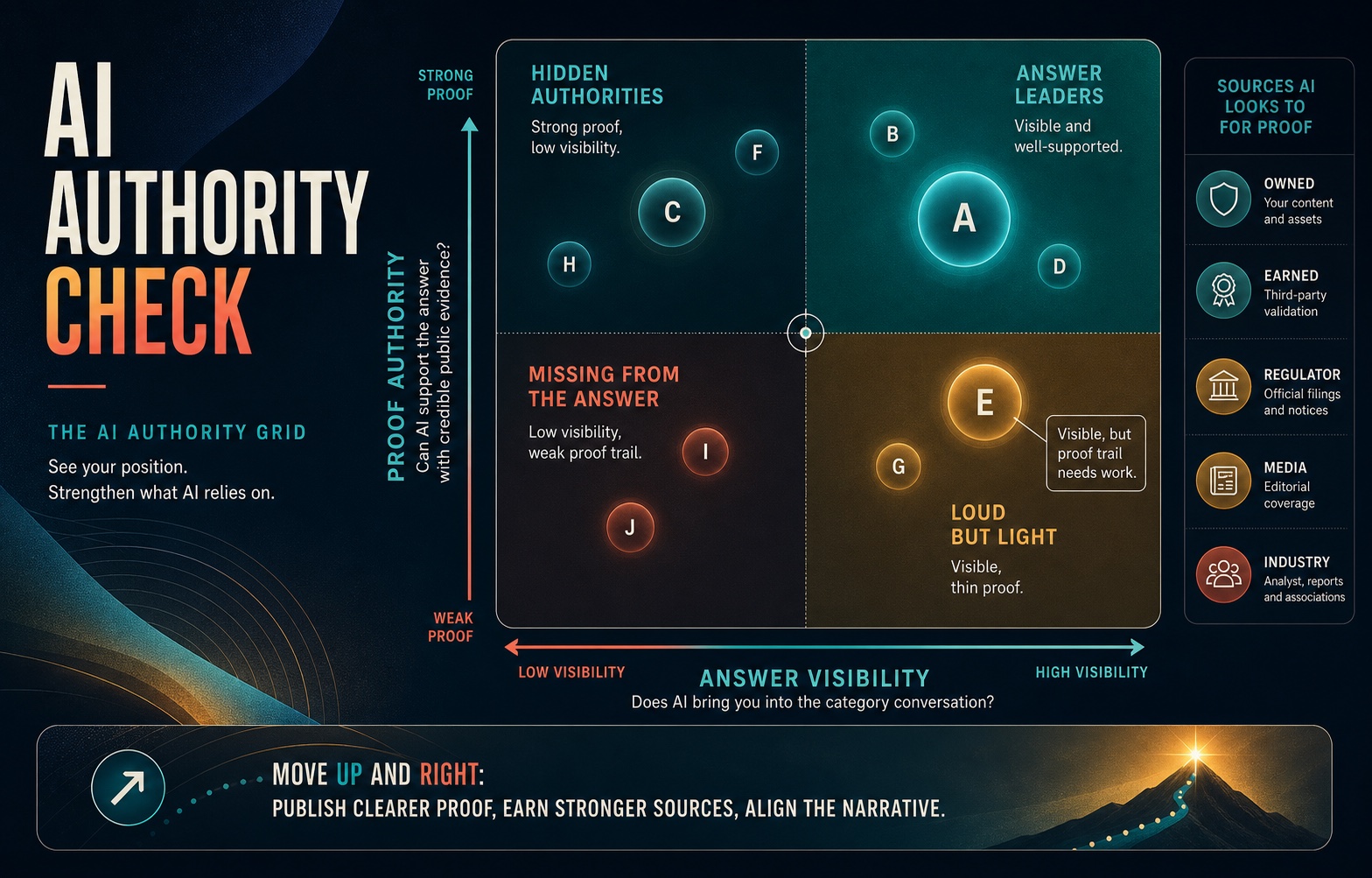
Example view across buyer-question groups. Labels show where a communications team should look first.
Pulse separates what the brand wants to be known for from what current evidence can support.
Pulse groups questions by buyer intent, then shows what the brand story needs before stronger language is used in sales or communications.
| Buyer question | Example finding | Recommended move |
|---|---|---|
| Which firms should be on a shortlist? | Category fit is visible, but independent authority is mixed. | Add dated third-party proof and clearer source labels. |
| Why switch from a known alternative? | Competitor descriptions are simpler and easier to repeat. | Clarify switching story with claim-safe comparison language. |
| Is the brand credible for urgent work? | Reputation signals need fresher source labels. | Refresh executive authority and crisis-readiness evidence. |
The sample distinguishes useful owned evidence from independent support that still needs to be strengthened.
| Source type | Quality band | Reviewer note |
|---|---|---|
| Owned proof | Usable with caveats | Good structure, but needs clearer dates and proof labels. |
| Earned/third-party | Thin | Useful for category legitimacy once source freshness is checked. |
| Executive authority | Partial | Needs stronger linkage between people, topics and proof pages. |
Pulse compares answer styles with source families, so teams can see whether a finding is supported by owned content, third-party context or stronger proof that still needs to be built.
| Answer surface | What appears | Source family | Confidence | Next review |
|---|---|---|---|---|
| General assistant | Category fit appears in several buyer questions. | Owned pages and reference sources. | Medium | Check whether third-party proof is current. |
| Search-augmented answer | Source traces are clearer, but dates vary. | Owned, earned and directory sources. | Medium-high | Review URLs, dates and claim support. |
| Enterprise assistant | Language is more cautious and less specific. | Mostly owned evidence. | Low-medium | Add independent validation before stronger wording. |
This view shows where the desired story is close to the evidence and where the communications work needs to come first.
Lower gap. The brand is found for the sample category, but wording should still be tightened.
Medium gap. The story is present, but competitors are easier to summarize.
Higher gap. Third-party support needs to be easier to find and cite.
Medium gap. Executive and source signals need fresher dated evidence.
High caution. Current dates and proof labels are needed before stronger market-facing language is safe.
First fix: refresh the source list and mark what each source can support.
Medium caution. The story is visible, but it needs more earned or third-party proof.
First fix: lift credible third-party validation into the proof hierarchy.
Medium caution. The category line should be shorter and easier to repeat.
First fix: simplify the switching story and retest the same buyer questions.
The sample shows where alternatives may be easier to explain. It does not rank competitors or claim market share.
| Theme | Demo observation | Action |
|---|---|---|
| Category clarity | Alternatives have shorter category labels. | Compress positioning into one repeatable line. |
| Proof hierarchy | Owned proof appears before independent proof. | Move third-party validation higher in the evidence stack. |
| Action follow-through | Guided review is the clearer next step for this sample. | Use the findings to decide whether a Snapshot, Deep Dive or access request is the right next move. |
Pulse avoids “AI recommends” language. It uses caution bands to show what must be improved before stronger positioning is used.
| Risk driver | Caution band | Next proof |
|---|---|---|
| Evidence freshness | High | Attach current source dates and reviewer caveats. |
| Independent authority | Medium | Add earned-source support before stronger language. |
| Message ambiguity | Medium | Retest after category and switching story cleanup. |
Questions cover category, problem, reputation, urgency and switching moments, then summarize the themes a buyer would notice.
Compares scoped model families and source types so teams can see whether proof is owned, earned, third-party or missing.
Flags message points that need source support before they become stronger sales or communications language.
Shows category framing and comparison themes without ranking competitors or claiming market share.
Labels risk as evidence, recency, clarity, source authority or reputation sensitivity so fixes are practical.
Turns the findings into PRecious advisory actions, platform follow-up steps and a clear retest plan.
Action: build one public proof page that ties services, source-backed examples, dated caveats and retest criteria together.
Action: sharpen the category line and message hierarchy before asking models, sales teams or media to repeat it.
Action: retest the same question set after source cleanup and keep language grounded in evidence.
Pulse is not just a visibility check. Each finding points to what to clarify, what proof is missing and which advisory conversation should come next.
AI answers can find the brand story, but the public evidence mix leans toward owned pages.
The brand story may be visible, but not yet backed by enough third-party confidence for stronger public language.
Build a proof hierarchy: owned explanation, dated third-party support, source caveats and a retest plan.
Alternatives appear with shorter category labels and fewer caveats in this sample.
Which buyer problem should the brand own first, and which proof can support that position today?
Do not say AI ranks or recommends the brand. Use this as a planning signal until source support is reviewed.
The issue is not only whether the brand appears; it is whether the sources are current and specific.
Refresh proof pages, executive authority and category language before using sharper market-facing claims.
Run the same buyer-question set again after proof updates to see whether answer quality and caveats improve.